
The Silent Assassin

The Silent Inflation Happening Inside Private Clubs Today
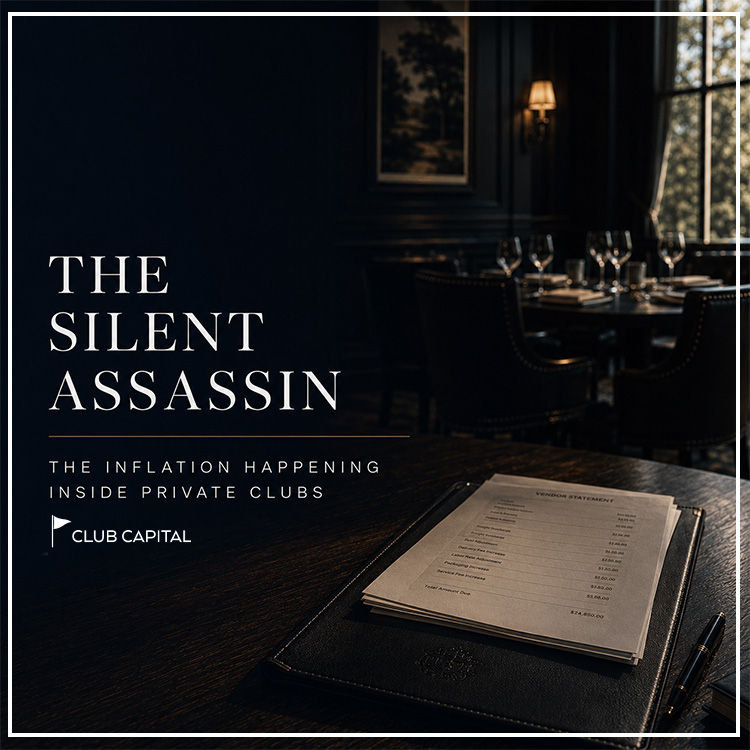
While inflation headlines have cooled compared to the volatility of the last several years, many private clubs are still experiencing significant operational cost pressure — just in a quieter, less obvious form.
For many clubs today, the challenge is no longer one dramatic increase that immediately triggers concern.
It’s the accumulation of dozens of smaller increases happening across the operation at the same time.
A slight adjustment in uniform pricing
An added freight surcharge
A revised chemical program
An increase in contracted labor rates
A foodservice item quietly rebid at a higher baseline
A linen agreement that hasn’t been benchmarked in years
A service vendor adjusting rates between seasons
Individually, these changes often feel manageable.
Collectively, they create meaningful pressure on operating margins.
And because the increases happen gradually, they often avoid the level of scrutiny that a major one-time expense increase would normally receive.
That is the silent inflation happening inside clubs right now.
Why This Matters More Than Ever
Private clubs are operating in one of the most complex business environments the industry has seen in years.
Labor costs remain elevated. Insurance premiums continue rising. Commodity markets remain volatile. Freight and logistics costs are still unstable in many regions.
Tariff uncertainty continues affecting manufacturing and imported goods categories. And suppliers across nearly every segment of club operations are attempting to protect their own margins at the same time.
The result is a purchasing environment where pricing pressure rarely arrives all at once.
Instead, it shows up quietly over time.
That gradual pace is exactly what makes it dangerous.
Most clubs are extraordinarily focused on member experience, staffing, programming, events, capital planning, and maintaining operational excellence across the property.
Procurement oversight often becomes reactive rather than proactive simply because leadership teams are managing so many competing priorities simultaneously.
That is not a criticism of operators.
It is the reality of modern club management.
But it also creates an environment where small pricing adjustments can compound significantly over a 12–24 month period before anyone fully recognizes the total impact.
The Categories Creating the Most Quiet Pressure
One of the biggest misconceptions in club procurement is the belief that savings opportunities primarily exist in major categories like broadline food distribution.
In reality, many of the most overlooked cost increases are happening in fragmented operational categories that receive less consistent benchmarking and review.
These often include:
Uniform and apparel programs
Chemicals and sanitation supplies
Linen services
Office supplies
Smallwares and disposables
HVAC and MRO services
Pool and turf chemicals
Kitchen equipment servicing
Regional foodservice distribution
Freight and delivery charges
Waste removal and environmental services
Many of these categories are managed through long-standing vendor relationships that may not have been competitively reviewed in years.
And importantly, many of those vendors are not acting in bad faith.
Most suppliers are facing legitimate increases in:
Labor
Fuel
Manufacturing
Transportation
Insurance
Compliance
Raw materials
The issue is not whether vendors have justification for certain increases.
The issue is whether clubs have visibility into how those increases compare against the broader market.
Because without that visibility, “we’ve always used them” can quietly become one of the most expensive phrases in club operations.
The Operational Psychology Behind Procurement Drift
Another reason silent inflation becomes difficult to identify is because operational relationships matter in the private club industry.
And they should.
Clubs value reliability. Consistency matters. Responsiveness matters. Relationships matter.
A supplier who solves problems quickly and understands club operations brings real value beyond price alone.
The problem occurs when familiarity replaces accountability.
Many clubs naturally avoid revisiting vendor agreements unless there is a major service failure. If operations are functioning smoothly, procurement review often moves lower on the priority list.
Meanwhile, incremental increases continue stacking quietly in the background.
A 4% increase here. A revised surcharge there. An updated labor fee. A “temporary” fuel adjustment that quietly becomes permanent.
None of these changes independently feel severe enough to disrupt the relationship.
But over time, they materially reshape the club’s cost structure.
This is especially important in today’s environment because many clubs are simultaneously dealing with:
Wage inflation
Tight labor markets
Increased member expectations
Capital project spending
Higher borrowing costs
Equipment replacement cycles
Supply chain volatility
In other words, clubs are operating with less margin for unnoticed leakage than they had five years ago.
The Clubs Handling This Best Are Creating Visibility
The clubs navigating this environment most effectively are not necessarily the clubs making the most aggressive cuts.
They are the clubs creating the most operational visibility.
They are:
Reviewing vendor agreements more consistently
Benchmarking pricing quarterly instead of every few years
Consolidating purchasing strategically where appropriate
Using purchasing data more proactively
Creating internal accountability around departmental spend
Evaluating total value rather than just invoice pricing
Treating procurement as a leadership-level operational strategy
That last point matters.
For years, procurement inside many clubs was viewed primarily as an administrative function.
Today, it is increasingly becoming a financial strategy function.
Because protecting margin in 2026 is no longer just about generating additional revenue.
It is about preventing unnoticed operational leakage before it compounds into a much larger problem.
The Opportunity Hidden Inside the Problem
The good news is that silent inflation also creates opportunity.
Many clubs assume meaningful savings can only come from large operational disruption — changing major vendors, overhauling systems, or restructuring departments.
In practice, some of the strongest financial improvements often come from identifying smaller inefficiencies spread across multiple categories.
Incremental improvements compound just as quietly as incremental cost increases do.
A better chemical agreement. Improved linen pricing. A stronger office supply program.
Reduced freight exposure. More competitive service structures. Better purchasing visibility across departments.
Individually, none may transform the budget overnight.
Together, they can create substantial operational improvement without negatively impacting the member experience.
And ultimately, that is the goal. Not simply reducing cost for the sake of reducing cost.
But helping clubs operate more efficiently while preserving the level of experience members expect.
Navigating the Storm
The private club industry continues to evolve rapidly.
Operating costs remain dynamic. Supply chains remain unpredictable. And many of the pricing pressures affecting clubs today are happening quietly beneath the surface rather than through dramatic headline increases.
That is why visibility matters more than ever.
The clubs that proactively evaluate their purchasing environment, benchmark vendor agreements, and create operational transparency will be far better positioned to protect margins moving forward.
Because the greatest threat to many club budgets today is not one major expense increase.
It is the slow accumulation of dozens of smaller ones that nobody notices until they become impossible to ignore.
At Club Capital Group, we work with clubs across the country to help identify these hidden operational pressures and create procurement strategies built for today’s market environment.
Not because clubs are doing anything wrong.
But because the operating environment itself has fundamentally changed.


Comments